Client ID, Object ID & Tenant ID: What’s the Difference?
If you’ve worked with Microsoft Entra, Microsoft Graph, or Azure Automation, you’ve probably come across three IDs:
- Client ID
- Object ID
- Tenant ID
At first glance, they all look like random GUIDs—and it’s easy to confuse them.
Knowing what each ID represents can save time when troubleshooting authentication issues, configuring applications, or working with Microsoft Graph.
Why Does It Matter?
Many Microsoft 365 tasks require one or more of these IDs.
For example:
- Registering an application
- Connecting to Microsoft Graph
- Configuring Azure Automation
- Creating API integrations
- Troubleshooting authentication
Using the wrong ID often leads to authentication failures or configuration errors.
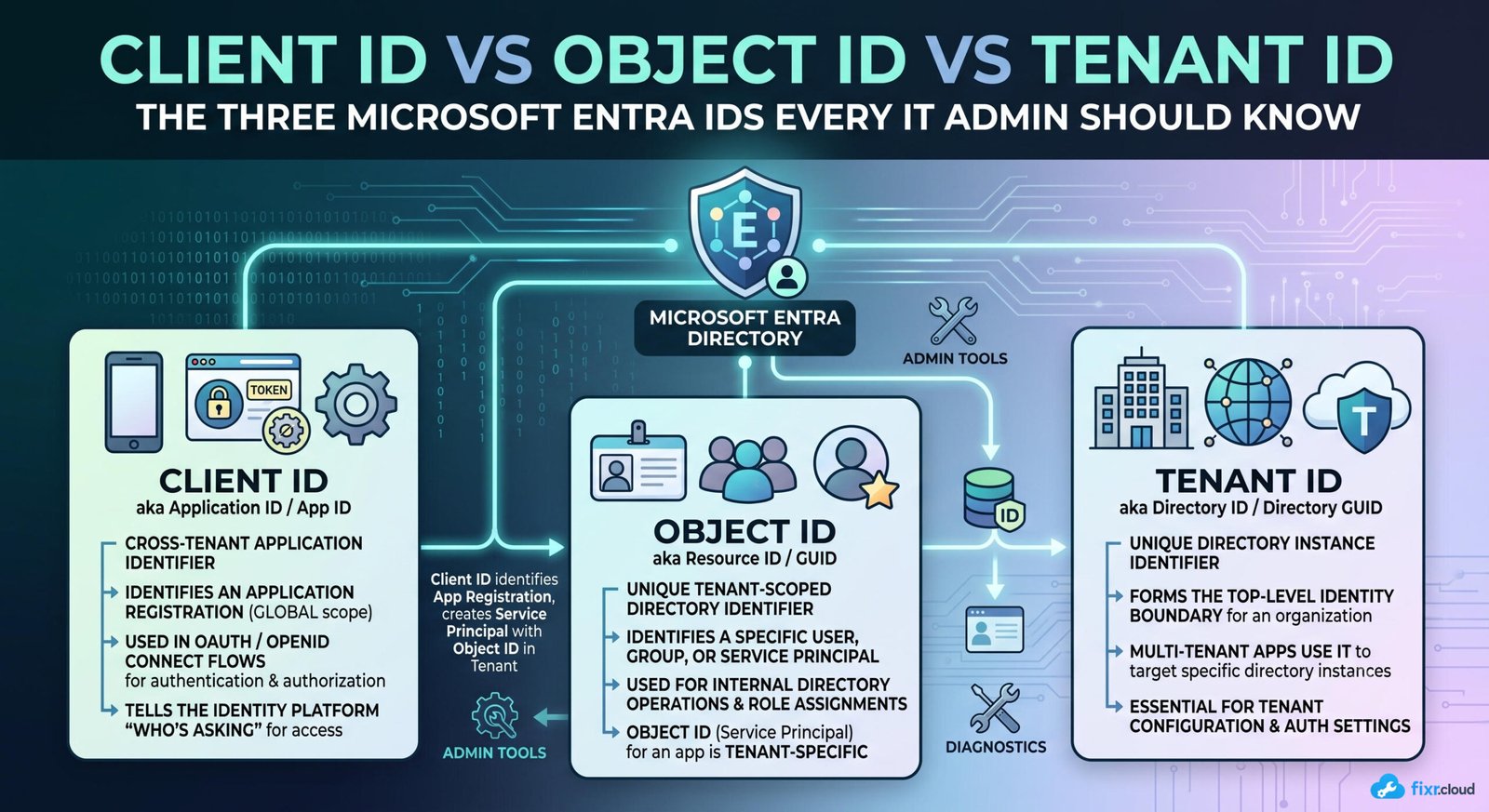
Client ID (Application ID)
The Client ID is the unique identifier of an application.
It tells Microsoft Entra which application is requesting authentication.
Think of it as an application’s passport number—it never changes for that application.
You’ll commonly use the Client ID when:
- Authenticating with Microsoft Graph
- Configuring OAuth
- Connecting PowerShell scripts
- Creating API integrations
Object ID
The Object ID identifies a specific object inside your Microsoft Entra tenant.
Every object has one, including:
- Users
- Groups
- Applications
- Service Principals
- Devices
Unlike the Client ID, the Object ID is unique to that object within your tenant.
Tenant ID
The Tenant ID identifies your Microsoft Entra directory.
Whenever an application authenticates, Microsoft needs to know which organization it’s connecting to.
That’s the role of the Tenant ID.
Every Microsoft 365 tenant has exactly one Tenant ID.
A Simple Way to Remember It
Think of a company:
- Tenant ID = The company itself.
- Client ID = An employee’s employee number.
- Object ID = The employee’s record inside the HR system.
Each serves a different purpose, even though they’re all unique identifiers.
Common Mistakes
- Using the Object ID instead of the Client ID in authentication scripts.
- Assuming the Client ID and Object ID are interchangeable.
- Forgetting that every tenant has its own Tenant ID.
Best Practices
- Label IDs clearly when documenting applications.
- Never expose Client Secrets alongside these IDs.
- Verify which ID a script or application expects before troubleshooting.
💡 Fixr.Cloud Insight
One of the most common support issues I’ve seen isn’t a broken script—it’s the wrong ID being copied.
Before changing permissions or rewriting code, double-check whether the application expects a Client ID, an Object ID, or a Tenant ID. That simple verification often resolves the issue within minutes.
🎯 Bottom Line
Remember this simple rule:
- Client ID → Identifies the application.
- Object ID → Identifies an object within your tenant.
- Tenant ID → Identifies your Microsoft Entra directory.
Once you understand these three IDs, working with Microsoft Graph and application authentication becomes much simpler.
Fixr.Cloud – Smarter IT, Simplified.