Whenever I evaluate an Azure environment, one question immediately tells me how mature the governance model is:
“How many Azure Policies are active and enforced?”
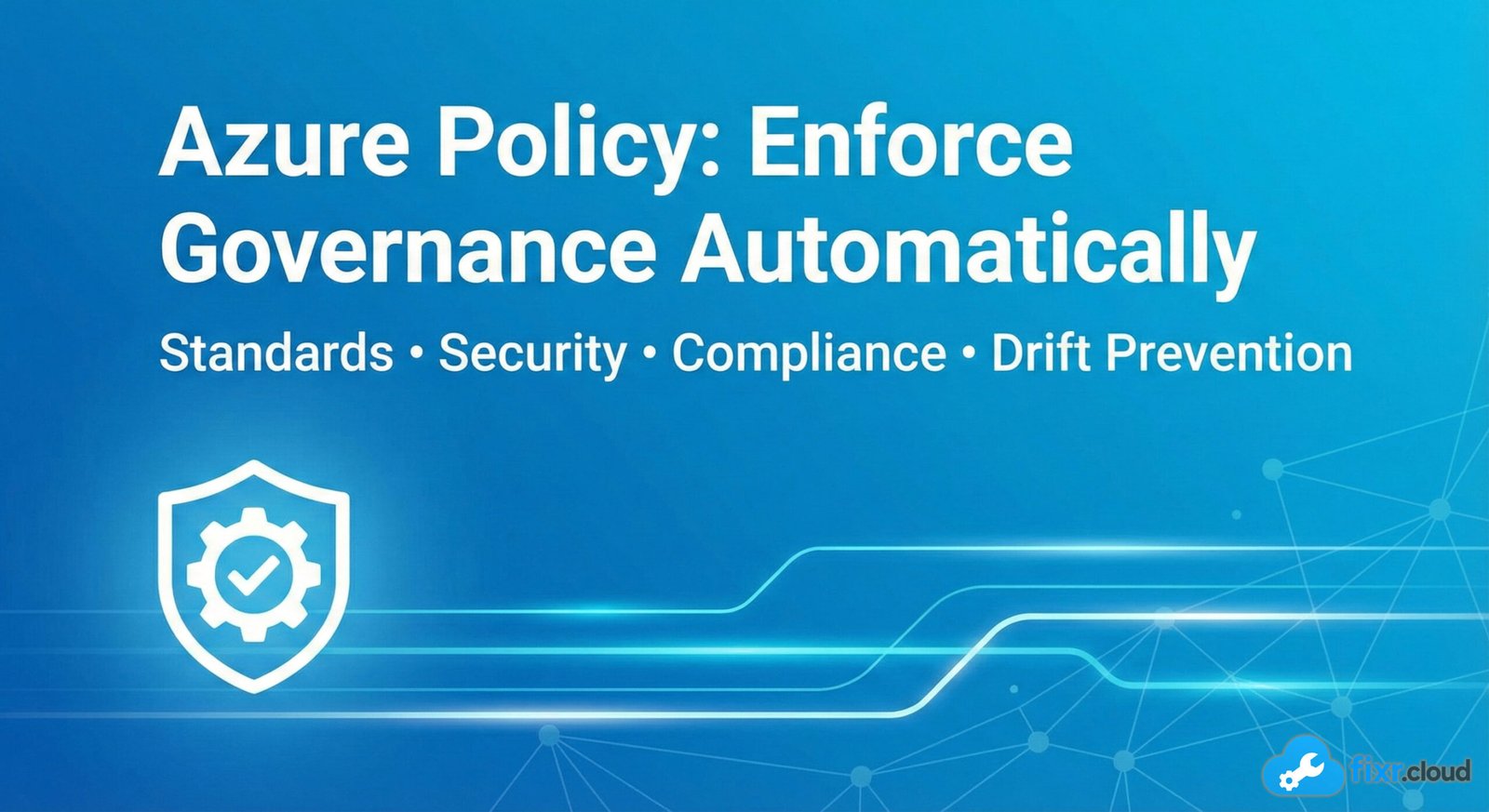
Azure Policy isn’t just another feature — it’s the backbone of a well-governed cloud platform.
If you want consistent deployments, secure defaults, predictable operations, and strong audit posture, Azure Policy is the tool that makes it all possible.
Here’s why I rely on it so heavily in real-world MSP environments.
What Azure Policy Actually Does
Azure Policy lets you define rules for how your cloud resources must be created and managed.
It can:
- Enforce configuration
- Audit compliance
- Deny non-compliant deployments
- Automatically remediate incorrect resources
With Policy, you’re no longer dependent on manual checks or documentation — the platform enforces your standards for you.
Why Azure Policy Matters
1. Enforces Standards Automatically
Manual governance never scales.
As the environment grows, you cannot expect teams to always follow best practices.
Azure Policy enforces rules such as:
- “All resources must have specific tags”
- “Public IPs are not allowed”
- “Only specific VM SKUs are permitted”
- “Key Vault must have purge protection enabled”
This keeps your environment clean and predictable.
2. Strengthens Security Posture
A lot of critical security baselines can be enforced with policy:
- Disabling public access
- Requiring disk encryption
- Ensuring secure parameters
- Blocking legacy networking configurations
- Enforcing private endpoints
This prevents misconfigurations before they happen — a major win for security.
3. Supports Regulatory Compliance
Azure Policy integrates with Azure’s built-in compliance standards like:
- CIS
- NIST
- PCI
- SOC2
- ISO 27001
This makes compliance reporting easier and much more accurate.
4. Enables Large-Scale MSP Operations
In MSP environments, you often manage:
- Multiple customers
- Multiple subscriptions
- Different architectures
- Mixed workloads
- Varying maturity levels
Azure Policy helps standardize governance across all tenants and subscriptions.
How I Use Azure Policy in Real Environments
1. Start With Built-In Blueprints
Microsoft provides excellent policy sets for:
- Security
- Networking
- DevOps
- Storage
- Identity
- Regulatory standards
I start with these and tailor them based on customer needs.
2. Build Mandatory Tag Standards
I enforce tags such as:
- Owner
- CostCenter
- Application
- Environment
- Department
This ensures cost visibility, tracking, and ownership clarity.
3. Use “Deny” Policies for Critical Settings
These stop non-compliant deployments instantly.
Example Deny Policies I use:
- Public IP creation
- Unapproved VM SKUs
- Non-encrypted disks
- Storage accounts with public access
- SQL servers without Azure AD authentication
4. Use “DeployIfNotExists” for Automatic Fixing
This is extremely useful for operational consistency.
Examples:
- Apply diagnostic settings automatically
- Enable encryption for storage accounts
- Enforce Key Vault soft delete
- Configure NSG flow logs
The platform fixes drift by itself.
5. Centralize Everything Under Management Groups
This keeps governance structured and easy to track:
- Tenant root
- Customer groups
- Production vs dev
- Environment-specific governance
Azure Policy in MSP Workflows
Azure Policy fits perfectly into an MSP ecosystem:
- Ensures customers stay compliant
- Reduces manual errors
- Keeps all deployments consistent
- Simplifies onboarding new environments
- Makes audits much easier
This is why it’s a foundational tool in my cloud governance practice.
Final Thoughts
Azure Policy is not a “nice to have.”
It’s a mandatory governance tool for any well-run Azure environment, especially at MSP scale.
By shifting governance from manual standards to automated enforcement, Azure Policy dramatically strengthens security, compliance, and operational consistency.
This is the kind of practical cloud guidance I share at Fixr.Cloud — Smarter IT, Simplified.